
By: Gabriela Sundquist
Read Time ~ 13 minutes
Content Warning:
This article is heavy but important. It was heavy for me, and I suspect it might be heavy for you. Please be aware that this article will discuss sexual assault, rape, sexual assault of a minor, statutory rape, sexual abuse, and more. If you need help please call the National Sexual Assault Hotline at 1-800-656-4673.
I fear often because this is a heavy and hard subject, that people like to assume that this is an “other” problem. “It hasn’t happened to me. It won’t happen to me. It hasn’t happened to anyone I love, and it won’t happen to anyone I love.” Unfortunately, this is a problem that is continuing and worsening. It isn’t going away. The problem? Sexual assault.
In fact, it is far more likely to win the lottery than to not know anyone who has experienced this. According to some statistics, 1 in 6 women has been sexually assaulted (though I’ve seen it as high as 1 in 4). According to this statistic, let’s break down some examples.
- According to The New York Times, the average American knows 600 people. Let’s say 300 of them are women. That means you know 50 women who have been sexually assaulted.
- According to Chelsidermy, the average amount of people Americans have in their close personal circle is 20. (I bet you can see where this is going.) If 10 of them are women, at least one of those women has been sexually assaulted.
It is very probable that if you don’t know of anyone who has been through this, it’s most likely that either they haven’t disclosed to you or haven’t disclosed to anyone. The point is, this is not an “other” problem. This is an everyone problem.
The statistics alone are staggering, but then you take into account the dark history of how sexual assault and rape have been handled in the court system. Most impactful of all are the hundreds of thousands of survivors and the experiences they went through.
The Statistics
The majority of the statistics in this article are from the RAINN (Rape, Abuse, Incest National Network). I also want to address that while these statistics are well-researched and sought out, these don’t address a large number of incidents and cases that go unreported every year.
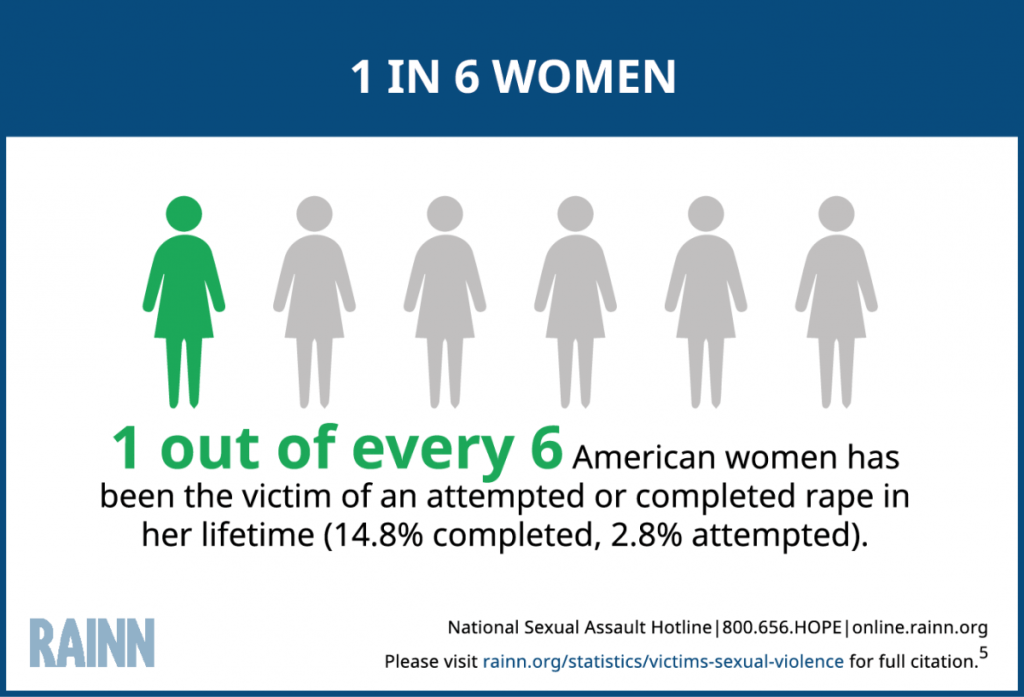
- 1 out of 6 American women has been the victim of an attempted or completed rape in her lifetime. (14.8% completed, 2.8% attempted)
- 1 out of 33 American men have been the victim of an attempted or completed rape in his lifetime.
- People ages 12-34 are at the highest risk for being a victim of rape and sexual assault.
- On average, each year there are 463,634 victims (ages 12+) of rape and sexual assault in the United States of America.
“Every 68 seconds, an American is sexually assaulted. And every 9 minutes, that victim is a child. Meanwhile, only 25 out of every 1,000 perpetrators will end up in prison.” – RAINN To put this in perspective, that means by the time you’ve finished reading this article, there will have been 14 Americans sexually assaulted, one of those being children. And there’s only a 2.5% chance that the perpetrators will end up where they belong.
The History
For a very long time rape and sexual assault were treated as a joke by the government. If perpetrators were persecuted at all, they received a light slap on the wrist and maybe some jail time. Maybe. But rape and sexual assault are no joke. They’re real and traumatic and they deserve to be punished. Robbers violate their victims right to security, and they’re punished. Murders violate their victims right to life, and they’re punished. Sexual predators violate their victims rights as well, and they must be punished. Not to mention, sexual predators often, not always, but often escalate to murder. Lock. Them. Up.
Speaking of robberies, Jane Manning the director of the Women’s Equal Justice Project, a nonprofit that advocates for survivors of sexual assault explains the injustice perfectly. The law and justice system used to have it so backward that if a woman in court gave testimony that she had been robbed and then raped, her testimony would have been enough to persecute the perpetrator for the robbery, but not the rape. If a woman said that she was sexually assaulted, she would need to provide hard cold external evidence. She would need to be corroborated. How does that make sense, you might ask? It doesn’t. Let’s discuss some more things that truly don’t make sense.
Barbara Bradley Hagerty wrote a tantalizing piece titled, “American Law Does Not Take Rape Seriously” in the Atlantic and discussed the disturbing and offensive history American law has with sexual assault prosecution with a central focus on the trial of Harvey Weinstein. Hagerty mentions that for a large majority of the past 60 years, American law has been based on a code written in 1962. The American Law Institute published the Model Penal Code in 1962 and “states drew heavily on the code [until] 2012”. Some of the atrocities listed in this code include:

- The “prompt outcry rule” stated that a woman must report an assault within three months
- The assault had to be “corroborated” with physical evidence. Her word couldn’t be taken.
- The woman had to prove “earnest resistance“, meaning there had to be proof that she fled or fought. (Even though that might put her life at risk.)
- If a woman went to court her character and sexual history were fair game. This means that defense attorneys could, and did, drag the victim through the mud any way they could with questions such as the following.
- Were you a virgin?
- How many sexual partners have you had?
- Why were you at (fill in the blank)?
- Why were you out so late?
- What were you wearing?
- There was no safe haven in the law for women who were married to a sexually abusive partner. In the laws eyes, if a husband sexually assaulted or raped his wife, that was his prerogative, because she was his property. Rape was essentially a part of the marital contract.
The “Change is Gonna Come”
Jane Manning said, “Rape laws in most states were written in such a way as to make rape virtually impossible to prosecute.” Fortunately, slowly things have begun to change. Slowly, in small bits and excruciating pieces, progress in American Law is being made.
- In the 1970s rules were put in place restricting attorneys’ abilities to bring the victim’s character into question. (BECAUSE IT’S NOT THE VICTIM’S FAULT.)
- In 1993, marital rape was “technically outlawed in all 50 states. About a dozen of states still have nasty loopholes in place to avoid prosecuting sexually abusive husbands”.
- States have abolished the “prompt outcry rule”.
- Most states have extended the statute of limitations. A handful of states still have a limitation of 10 years or less for a victim to press charges.
- All states have eliminated the corroboration requirement.
The system is far from perfect but progress is being made. A lot of that has to do with the incredible people who share their stories: survivors who have grown tired of waiting for justice. There are so many incredibly brave people who have shared and fought and refused to give up until justice is achieved. Let’s talk about some of them now.
A Few of the People
Survivors come in many shapes and forms, just as people do. No matter the stage or phase or place a survivor is in, their recovery is still crucial and their experience still real. Some survivors share their stories and are at the forefront of fighting, while others process more silently. I know survivors. I love survivors. I am a survivor.
There are many incredible resources for finding people who have experienced rape and sexual assault. These people are helping spread awareness and bring comfort to those who have experienced as well. Some of the people and their stories that have inspired me are as follows:
Samentha
Samentha was raped not once, not twice, but three times in her life. These multiple incidents of sexual assault by a stranger left her feeling lost and self-conscious. She says, “I felt like a broken record. It was embarrassing for me. I told people after the first and the second… but after the third [rape] I felt like a freak show.” She reported her first two rapes and was frustrated by the lack of police action. When the third rape happened, she hesitated to report it, but her boyfriend eventually reported it.
After all of that, her perpetrator was arrested, tried, and not convicted.
She says that she’s grown more comfortable talking about what happened and looks for friends and family that are comfortable with an open dialogue to help support her. Learn more about her story here.
Lea
When Lea was only 14 years old she was sexually assaulted at a party. For years she kept it to herself, wrapped in shame. In college when a friend disclosed her own experience, Lea finally felt able to disclose her experience all those years ago. She was having a hard time putting a word to what happened to her.
“People treat survivors with suspicion.” Lea expresses, “If you wait to disclose, you lose credibility. You become an imperfect victim. They ask ‘if it was that upsetting, why didn’t you do something differently?’”
Lea
Learn more about Lea and her experience here.
Sydney
Sydney was alone in her experience for a decade. She finally disclosed to her husband. She explains that she didn’t feel like she could share her experience because it didn’t fit into what she understood as rape. It was somebody that she knew, so she didn’t know how to give it a name. RAINN reports that actually around 80% of rapes are perpetrated by someone that the victim knows.
Sydney states, “There’s no guidebook on how to be a survivor, and each person’s story is different. It’s up to you whether reporting is the right choice.” Read more about Sydney’s story here.
Darchelle
Darchelle grew up in a military family and knew that’s what she wanted to do when she grew up. Unfortunately, her experience was very different than her father’s. One month into her service, her superior started saying inappropriate things to her, and eventually sexually assaulted her. She reported him, and he was flown off the ship and stripped of his rank. Many people ended up blaming her for him losing his rank, and she transferred to Italy.
In Italy, she had one of her friends she worked with over for dinner. After dinner she went upstairs to go to bed. As she was in bed her “friend” came into her room and raped her. Her son came up to her bedroom door, saw what happened and ran down to the front gate to alert security.
Fortunately, they had so much proving that this man had done wrong. Evidence including:
- fingerprints
- pictures of the door he broke into
- pictures of the lock on the door that he busted
- Darchelle’s clothing with a broken zipper
- his DNA on her comforter
- DNA in her rape kit
All of this evidence, yet the man got off scot-free. It came down to a matter of consent. While the court accepted that Darchelle and this man had intercourse, they said that it couldn’t be proven that it wasn’t consensual. Learn more about Darchelle and her experience here.
The Social Change That Needs to Come
Honestly, I worry about having children and finding people I trust to watch them. I worry about my mom and my sisters. I worry about my friends and people that I love so much experiencing this. With so many instances and experiences where justice is not served, I know that the power lies with us. The power lies in telling the truth, connecting with trusted people, and not shutting up until justice is served.
I know that the scale doesn’t feel even. I know it feels like a nearly impossible task sometimes. There are so many nasty situations in the world. For example, April 24th being named “National Rape Day” in a terrible tasteless hoax. This can be traced back to 2021 and allegedly started with a viral TikTok video of six ‘men’ urging each other to commit sexual crimes on April 24th of that year. This terrible hoax has resurfaced every year since then. When will sexual assault and rape stop being viewed as a joke or something to make light of? It makes me sick.
I am a religious person and for me, my faith is a place of comfort. I know many of you don’t share my views and find comfort in other ways and places. I will discuss that in a moment, but first I want to share how my faith helps me.
Sometimes things like this overwhelm me and it feels like there’s no chance of winning this battle. Then I remember my Heavenly Father. When I feel like the world has turned over and everything is on its head, I remember Him. He loved me enough to send His Son and He loved me enough to give me agency. While sometimes the way other people use their agency breaks my heart, I know that Heavenly Father is a just God. And I know that he doesn’t take it lightly when people take others’ agency, their God-given gift, away. It’s an overwhelming task, this I know. But I know that I can trust in God to deliver justice. Until then, I can use my power and agency to try to make a better world.
For those who aren’t religious, know that you’re not alone. The community is growing and talking about experiences more than ever. We no longer have to suffer in silence out of shame or fear. And I am a safe space for anyone who wants to talk. Healing is a personal journey and however you choose to do that is right for you.
The power is starting to shift in our favor. It’s already begun. With the #MeToo Movement and people taking down names such as Harvey Weinstein and Jeffrey Epstein, people are finally seeing a taste of justice.
The power truly lies with us, to tell the truth, tell it loud, and tell it until our voices run dry. Only then will we write a better and a more just future. The power no longer lies with the people who use power to control others. It is with us and I for one, am not giving it back to them any time soon.
Sources
Thank you to all of these wonderful people for sharing their stories so bravely on RAINN and Protect Our Defenders. There are so many more stories on these websites and countless others. When we share our experiences we create connection and space for more people to share. Both sharing our own stories and hearing others’ stories are incredibly healing.
If you need help or you need to talk, call the National Sexual Assault Hotline at 1-800-656-4673, or text “HOME” to the Crisis Text Line at 741741.
 Meditation, Mindfulness and Murder
5 responses to “Sexual Assault Awareness Month: Connection, Healing and Justice”
Hey there! Your blog is an incredible resource for anyone interested in googleads . Your best-practices are incredibly informative and have guided us in our own efforts to improve in the industry . We especially loved your recent posts about home-and-garden . Keep up the fantastic work and we look forward to reading more from you soon!
Appreciate this content
Legendary Business Ventures
Blogger
http://www.clickedprofits.co.uk
LikeLike
We love reading your blog! Your unique perspective and real voice are game-changers in the world. Keep writing, because your ideas make a difference. Thank you for being you!
Thanks – TheDogGod
LikeLike
Hey there! We really enjoy reading people’s blogs and the entertaining content that creators like you publish. Your personal experiences enhances the engaging online community that we all cherish . Keep writing and connecting your audience, because your ideas can make a significant impact on the world. We can’t wait to read what you’ll create next!
Thanks – pomeranianpoppa
LikeLike
Great Read Can i leave my thoughts ?! –
Thanks for reading , Love The Blog !!
Thanks – TheDogGod pomeranianpuppies.uk Thanks – Pomeranian Puppies & Adult Dog Guides & Tips http://pomeranianpuppies.uk
LikeLike
Reblogged this on por291 and commented:
This is a very sad reality that we all need to be more informed about. Awareness is the first step towards change.
LikeLike